The United States launched a large scale military operation against Venezuela in the early hours of January 3, triggering airstrikes in Caracas and culminating in the capture of Venezuelan President Nicolás Maduro. The operation, described by US officials as a precision mission, has sent shockwaves through Latin America and beyond, prompting global condemnation, emergency diplomatic meetings and renewed debate over international law, sovereignty and regime change.
US President Donald Trump confirmed that Maduro was taken into custody by US forces and transferred to New York, where he is expected to face multiple criminal charges in federal court. Trump later shared an image of a handcuffed and blindfolded Maduro aboard a US warship, calling the operation a decisive moment in Washington’s long running confrontation with the Venezuelan leader.
Airstrikes Rock Caracas
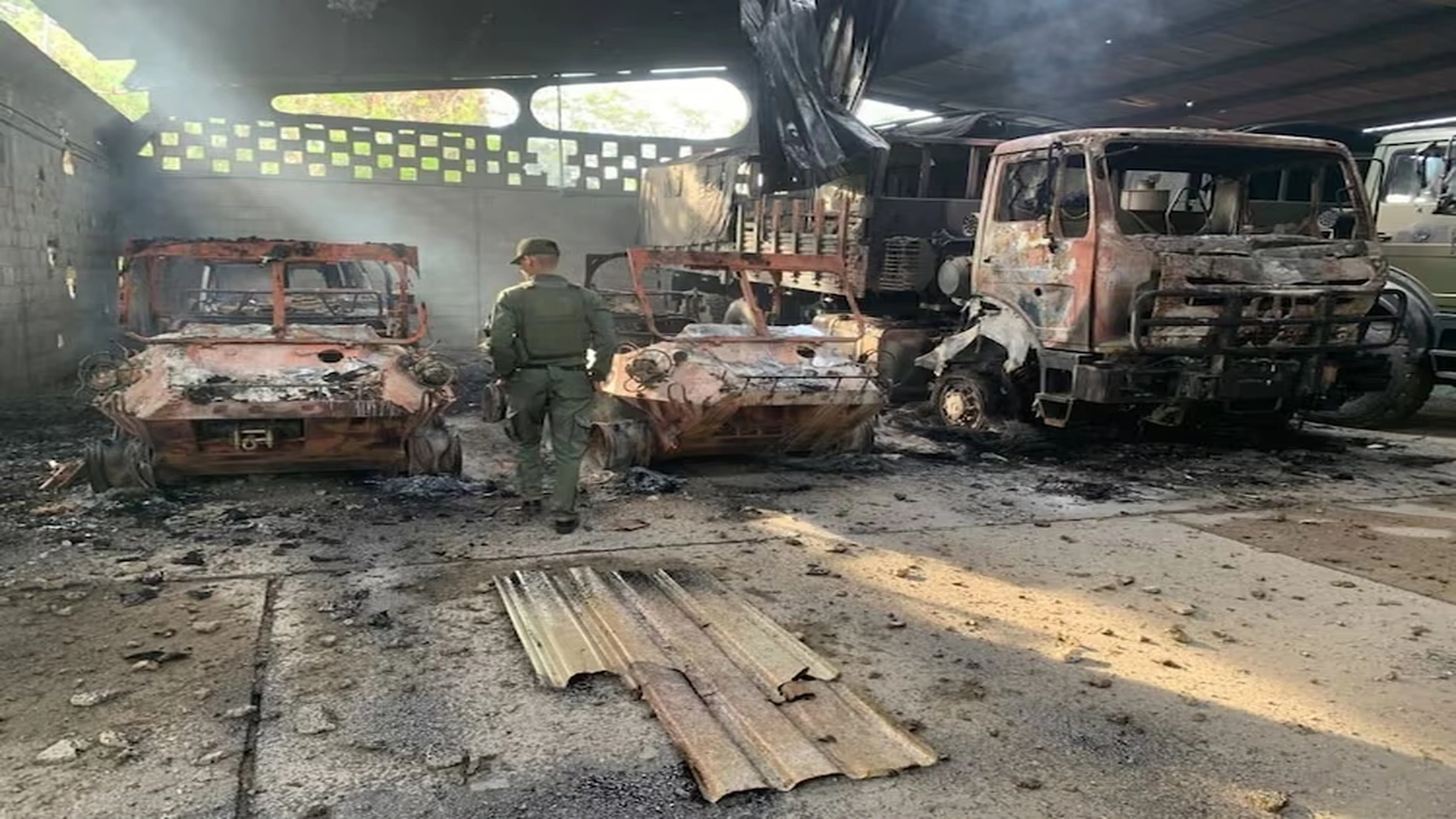
Residents of Caracas reported explosions, low flying aircraft and widespread power outages as US forces struck key military and government installations across the capital. Smoke was seen rising from areas near Fort Tiuna, the country’s main military base, and other strategic locations. Venezuelan officials later said at least 40 people were killed in the strikes, though the full civilian toll remains unclear.
The Pentagon said the mission was carefully planned to minimize civilian harm and was timed to take advantage of a narrow weather window. According to US military briefings, more than 150 aircraft, including fighter jets, bombers and drones, supported helicopters that entered Venezuelan airspace to extract Maduro and his wife, Cilia Flores.
Maduro Taken to the United States
Within hours of the operation, US officials confirmed that Maduro had been flown out of Venezuela and brought to the United States under heavy security. He arrived first at a military airbase before being transferred by helicopter to federal facilities in New York. Visuals showed Maduro escorted by multiple federal agents as authorities sealed off nearby areas.
The US Attorney General said Maduro and Flores have been indicted in Manhattan on charges including narco terrorism conspiracy, cocaine importation conspiracy and weapons related offenses. Maduro is expected to make an initial court appearance on Monday.
Trump Says US Will Run Venezuela Temporarily
In a series of statements following the operation, President Trump said the United States would oversee Venezuela for the time being until a transition of power could be arranged. He also announced plans to tap Venezuela’s vast oil reserves, arguing that revenues from oil sales would cover the costs of US involvement.
Trump described the strikes as one of the most effective military operations in American history and insisted no US troops were killed. He warned that Washington was prepared to launch further action if necessary.
Interim Leadership Declared in Caracas
Amid the turmoil, Venezuela’s Supreme Court announced that Vice President Delcy Rodríguez would serve as interim president. Speaking on state television, Rodríguez rejected US claims of a lawful arrest and called Maduro’s capture a kidnapping. She urged calm, unity and resistance against what she described as foreign aggression, insisting that Venezuela would never submit to external control.
Opposition leaders, however, welcomed Maduro’s removal, with some calling for a rapid transition and fresh elections. They argued that the operation opened a path toward restoring democratic order after years of political repression and economic collapse.
International Reaction and Condemnation
The US strikes drew swift reactions from around the world. Russia and China condemned the operation as a violation of international law and demanded Maduro’s release. Several Latin American countries, including Brazil and Chile, expressed deep concern, warning that the action set a dangerous precedent and risked destabilizing the region.
The United Nations Security Council is scheduled to meet in emergency session after multiple countries requested urgent discussions. UN Secretary General António Guterres warned that unilateral military action against a sovereign state could undermine global norms and fuel wider conflict.
European leaders offered mixed responses. British Prime Minister Keir Starmer said his government shed no tears over the end of Maduro’s rule but emphasized the need for a peaceful transition. Australia and Canada called for restraint, dialogue and respect for democratic principles.
Domestic US Debate Intensifies
At home, the operation has sparked sharp political divisions. Several Democratic lawmakers criticized Trump’s decision, questioning its legality and warning of the risks of another regime change conflict. Vice President Kamala Harris said the action did not make the United States safer and accused the administration of acting without clear legal authority or an exit plan.
Protests erupted in New York and Washington, with demonstrators calling the strikes an act of war and demanding respect for international law. At the same time, members of the Venezuelan diaspora in Florida gathered to celebrate Maduro’s removal, describing it as long awaited justice.
Impact on Travel and Energy Markets
The military operation disrupted regional travel as US authorities closed portions of Caribbean airspace, forcing major airlines to cancel hundreds of flights. The US Embassy warned citizens to avoid travel to Venezuela, reiterating that the country remains under a Level 4 Do Not Travel advisory with no commercial flights operating.
Energy markets are closely watching developments, given Venezuela’s role as a major oil producer. While US officials said key oil facilities were not damaged in the strikes, uncertainty remains over future production, exports and control of infrastructure.
What Comes Next for Venezuela
With Maduro in US custody, Venezuela faces an uncertain future. Analysts outline several possible scenarios, ranging from a constitutional transition under interim leadership to a power struggle involving the military or opposition forces. The risk of prolonged instability remains high, particularly if loyalist factions resist US backed changes.
For now, the focus shifts to New York, where Maduro’s court proceedings are expected to draw intense international attention. Legal experts say the case could raise unprecedented constitutional and international law questions, given that a sitting foreign head of state has been captured and brought to trial by another country.
A Turning Point With Global Consequences
The US strikes on Venezuela mark one of the most dramatic interventions in the Western Hemisphere in decades. Supporters see the operation as a decisive blow against an authoritarian leader accused of corruption and human rights abuses. Critics argue it undermines international law and risks plunging the region into prolonged conflict.
As diplomats scramble to contain the fallout and Venezuelans brace for what comes next, the events of January 2026 are likely to reshape geopolitics in the Americas and redefine how power is exercised on the global stage.
Comments
Post a Comment